
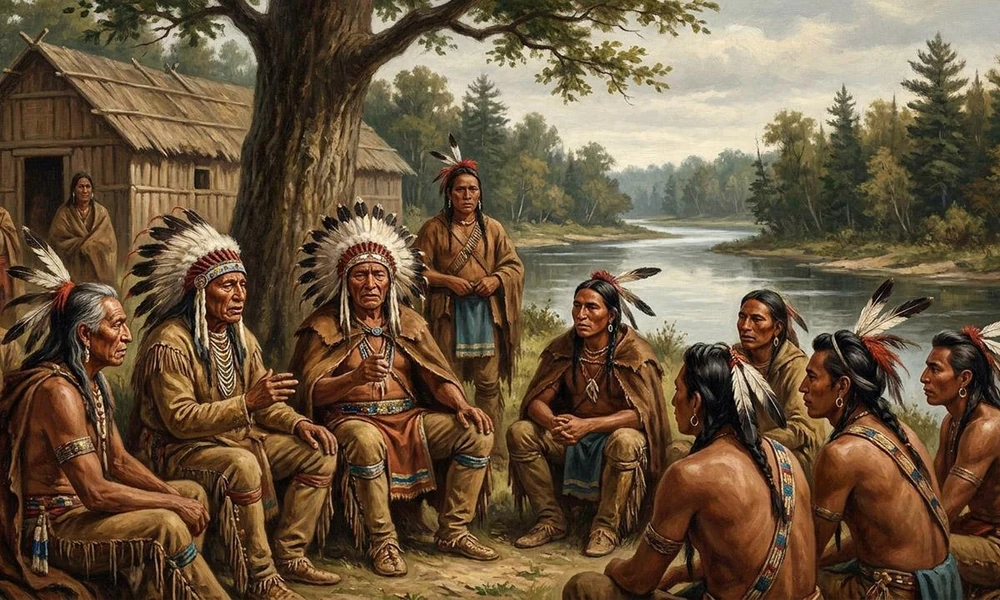

The Revolution is usually taught as colonists against the crown. For the most powerful confederacy in the region, it was a war that turned nation against nation
Key Takeaways
● The Haudenosaunee (Iroquois) Confederacy, one of the most powerful political alliances in North America, split during the Revolution: the Oneida and Tuscarora sided with the Patriots, while the Mohawk, Seneca, Cayuga, and Onondaga largely sided with the British.
● At the 1777 Battle of Oriskany, Oneida and Tuscarora warriors fought directly against Mohawk and other British-allied Haudenosaunee nations, producing at least 200 casualties among people who had been part of the same confederacy.
● The 1779 Sullivan Expedition, a Patriot military campaign, destroyed dozens of Haudenosaunee villages and food stores largely regardless of which side individual communities had actually taken.
● The 1783 Treaty of Paris settled the war between Britain and the United States without any Native representation, ceding lands Haudenosaunee and other Native nations still occupied and fought for.
● The Confederacy’s centuries-old political unity, built around the Great Law of Peace, never fully recovered from the divisions the war forced onto it.
Most classroom timelines treat the American Revolution as a two-sided conflict: colonists against the British crown. For the Haudenosaunee Confederacy, one of the most sophisticated political alliances in North America at the time, the Revolution was not a war they watched from the outside. It was a war that split their confederacy in two, pitting member nations against each other in ways the war’s standard narrative rarely mentions.
Not Bystanders: Native Nations and the Choice to Take Sides
Native nations across the eastern seaboard were not passive observers of a colonial dispute. They were sovereign political actors weighing which side, British or Patriot, was more likely to respect their land and autonomy going forward, and different nations reached very different conclusions based on their histories with colonial expansion.
For over a century before the Revolution, the Haudenosaunee had maintained influence by balancing rival European powers against each other. The Revolution forced an end to that balancing act, requiring nations that had coexisted within one confederacy to choose a side in a conflict that was, at its core, not their own.
The Split of the Haudenosaunee Confederacy
The Haudenosaunee Confederacy, made up of six nations, divided during the Revolution: the Oneida and Tuscarora allied with the Patriots, while the Mohawk, Seneca, Cayuga, and Onondaga largely sided with the British. Patriot officials like General Philip Schuyler actively courted Oneida support with promises of protection, supplies, and shared “liberty and property,” and the Oneida became genuinely valuable to the Patriot cause as warriors, guides, and intelligence sources.
This was not a minor disagreement resolved diplomatically. It fractured a confederacy that had functioned as a unified political entity for generations.
EVIDENCE CHECK: The Revolution is commonly taught as a conflict between two sides. For the Haudenosaunee, it was closer to a civil war layered on top of an external one, with member nations of the same confederacy fighting directly against each other.
The Battle of Oriskany: When Confederacy Fought Confederacy
In August 1777, Oneida and Tuscarora warriors fought alongside Patriot forces against Mohawk and other British-allied Haudenosaunee nations at the Battle of Oriskany, one of the bloodiest engagements of the northern campaign, producing at least 200 casualties. This was not a battle against an unfamiliar enemy. It was, in a very real sense, Haudenosaunee fighting Haudenosaunee.
At Oriskany, the deepest divide of the battle ran through a single confederacy, not between colonies and the crown.
The aftermath was just as damaging as the fighting itself. Communities on both sides raided each other’s settlements in the following months, and most Mohawks fled to Canada or British-held Niagara, further deepening a rift that combat alone had already made severe.
The Sullivan Expedition: Scorched Earth Regardless of Allegiance
In 1779, Continental forces under General John Sullivan launched a campaign specifically aimed at destroying Haudenosaunee villages, crops, and food stores across what is now central and western New York. The expedition targeted the confederacy broadly, and the devastation fell heavily on communities regardless of whether they had formally allied with the British or attempted to remain neutral.
This is one of the clearest points where the standard “Patriots versus loyalists” framing breaks down entirely. Sullivan’s campaign was not aimed at punishing disloyalty to the Patriot cause specifically. It was aimed at removing Haudenosaunee presence and food security from the region, a goal that did not distinguish carefully between allies, enemies, or neutral parties.
The Haudenosaunee Were Not Alone
The pattern of Native nations weighing sovereignty and land protection against two competing colonial powers played out well beyond the Haudenosaunee. In the South, Cherokee towns fought an extended campaign against colonial expansion into their territory during the same years, largely aligning with the British for reasons similar to the Mohawk and Seneca: British policy, however imperfectly enforced, had at least nominally limited colonial settlement west of the Proclamation Line of 1763, while Patriot militias and land speculators posed a direct, ongoing threat to Cherokee land.
The details differed nation to nation, but the underlying calculation was consistent across much of the eastern half of the continent: Native nations were not choosing between “British” and “American” as abstract identities; they were choosing whichever side seemed less likely to keep taking their land.
Left Out of the Peace: The Treaty of Paris and Native Land
The 1783 Treaty of Paris formally ended the war between Britain and the United States and ceded vast territories, including land that Haudenosaunee and other Native nations still occupied and had fought over, without any Native representation in the negotiations. Nations that had allied with the British found that Britain’s peace terms did nothing to protect the land or sovereignty they had been promised, while those that had allied with the Patriots, like the Oneida, received little durable protection either.
The peace treaty settled a dispute between two governments over territory that, in practice, neither government fully controlled or had the right to divide in the first place.
Why “Three Sides” Is a More Accurate Framing Than “Two”
Framing the Revolution as strictly colonists against the crown erases a war that, for Native nations, was fought on its own separate axis, one where the outcome mattered enormously but where neither combatant’s victory promised a positive result. Whether the Haudenosaunee allied with the British or the Patriots or attempted neutrality, the postwar consequences, land loss, displacement, and a fractured confederacy followed regardless of which choice individual nations made.
That is a fundamentally different war than the two-sided story most classrooms teach, and it is one where the losing side, in practical terms, included people who had fought on both.
Why It Still Matters
Treating Native nations as background scenery in the Revolution, rather than as sovereign political actors making high-stakes strategic choices, flattens one of the most consequential aspects of the war. The Haudenosaunee split shows that the Revolution’s real dividing lines did not always run where the standard narrative places them, between colonists and the crown, but through communities and confederacies that had their own histories, alliances, and reasons for choosing as they did.
It also reframes the postwar period honestly: independence for the United States did not mean protection or justice for the nations whose land and alliances had shaped the war’s outcome.
FAQ
Did Native American nations take sides in the American Revolution? Yes, extensively. Native nations were sovereign political actors who weighed their own interests, and different nations, sometimes even within the same confederacy, allied with the British or the Patriots or attempted to remain neutral.
How did the Haudenosaunee Confederacy split during the Revolution? The Oneida and Tuscarora nations sided with the Patriots, while the Mohawk, Seneca, Cayuga, and Onondaga largely sided with the British, fracturing a confederacy that had functioned as a unified political alliance for generations.
What happened at the Battle of Oriskany? In 1777, Oneida and Tuscarora warriors fought alongside Patriot forces against Mohawk and other British-allied Haudenosaunee nations, producing at least 200 casualties in a battle that effectively pitted the confederacy against itself.
What was the Sullivan Expedition? A 1779 Continental military campaign that destroyed dozens of Haudenosaunee villages and food supplies across what is now New York, targeting the confederacy broadly regardless of which side individual communities had allied with.
Did the Treaty of Paris protect Native land claims? No. The 1783 treaty ceded territory that Native nations still occupied without any Native representation in the negotiations, leaving both British-allied and Patriot-allied nations with little protection for their land or sovereignty afterward.
Further Listening & Reading
For more on the perspectives left out of the standard two-sided narrative, explore the AAR interview series and the Themes of the American Revolution collection. Our related piece on Spain’s forgotten role in the American Revolution looks at another set of stakeholders whose interests rarely make it into the standard telling.
